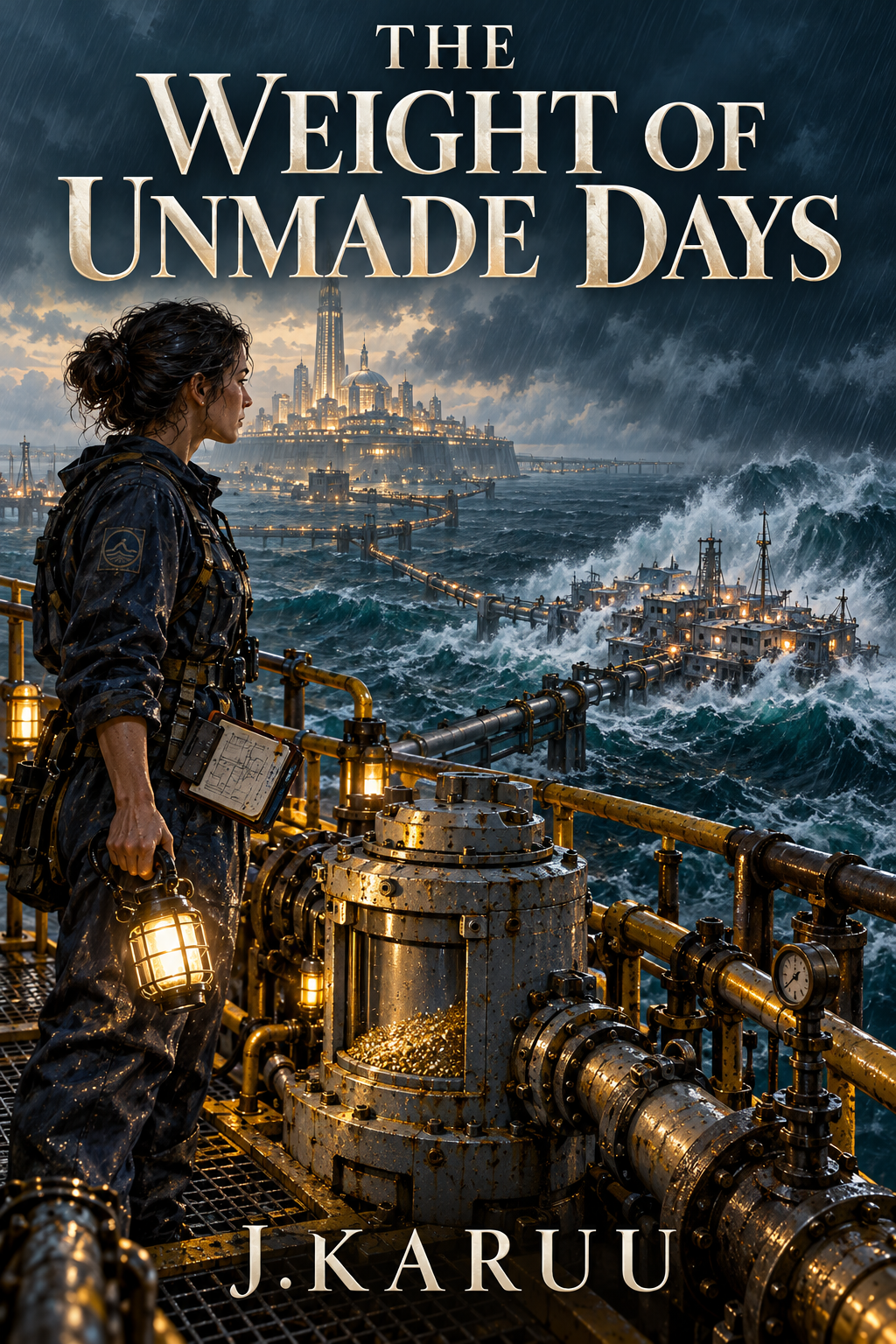
The pump had survived, which was why Mara distrusted it.
She stood on the grated inspection platform with one hand against the bearing housing and felt a small irregular knock travel through her palm. Beneath her boots, seawater struck the underside of the district raft. The two rhythms almost matched. She waited through several waves until she could distinguish the machine’s hesitation from the movement of the floor.
Behind her, Supervisor Deren held out the morning work order.
“Temperatures have been green since six.”
“Then you’ve had green temperatures for two hours.”
“And water for eleven thousand people.”
Mara took her hand away. A smear of yellow lubricant marked the heel of it. She rubbed it between finger and thumb, found grit, and wiped both on the white cloth she kept folded in her sleeve.
The stain glittered.
“Inspection port,” she said.
Deren looked toward the reservoir display above the stairs. Thirty-eight percent. Someone had drawn a preferred minimum of fifty on the glass, a red line the falling blue column had passed during the night.
“How long?” he asked.
“To open the port? A minute.”
“To find something that lets you sign.”
She set her bag down on the dry side of the platform.
Outside the high windows, morning light lay flat across Nacre’s ocean. A freight barge rose behind the breakwater and disappeared again. On the wall beside the safety station, the seasonal forecast counted forty-one days to storm maximum. Below it, a handwritten notice asked workers to return borrowed waterproofs.
Mara clipped her lamp to the port rim. The viewing shield was clouded with oil, but a clean section showed the bearing’s outer race. A bright groove ran through its dull surface. She turned the lamp, changing the reflection until the groove remained visible from both angles.
“Scored,” she said.
“How badly?”
“Enough that I want the lubrication history.”
Deren stopped holding out the work order.
At the control bench, a young fitter named Pei brought up the overnight record. Pressure rose steeply at 03:17, held for less than four seconds, then dropped. The pump’s protection circuit had registered the surge. It had issued a speed correction, but the shaft response lagged behind the worst of it.
“No trip?” Mara asked.
“Never reached the trip duration,” Pei said.
“Relief valve?”
“Moved six percent. Late.”
That movement would have helped afterward. It could not explain what the bearing had endured before it.
Mara asked Pei to leave the trace open and went back to the housing. She watched the transparent feed section. Oil crept through, stopped, then arrived in a sudden thick bead.
“Again,” she said when Deren began speaking.
They watched another cycle. This pause lasted longer.
Deren bent closer. “We changed the filter last week.”
“The blockage could be downstream.”
“It could have cleared.”
A bead formed and hung motionless in the line.
Mara looked at him.
“All right,” he said.
She recorded the score, the interrupted feed, the pressure peak and the delayed protection response before opening the lattice panel. Measurements first. If she started with an explanation, she had a habit of finding the evidence for it.
The panel occupied a narrow cabinet behind the motor, kept clear of ordinary tools by a yellow rail. Its stabilizer gave off a high, steady note that made her back teeth feel crowded. Through a window she could see the engine’s sealed core, a gray cylinder no longer than her forearm.
The intervention counter had advanced once overnight.
Pei leaned over her shoulder. “That’s what saved it, then.”
“Possibly. Get me the local vibration buffer.”
“Isn’t that enough?” Deren asked.
“Enough to know it intervened.”
She put the pressure and vibration traces together. At the surge peak, the shaft had wandered toward the damaged side of the bearing. It had then settled within clearance. No impossible movement, no restoration of worn metal. The oil film, thin as it was, could still have carried the load if the rolling elements passed the score at favorable moments.
They had.
She enlarged the next half second. The dangerous oscillation diminished in several uneven steps. The lattice event occupied the same interval.
“It kept finding room,” she said.
Deren folded his arms. “So it works.”
“Yes.” She pointed toward the housing. “And the groove is still there.”
The engine could favor a motion the machinery remained capable of making. It could not supply oil through a blocked feed or put metal back onto a race. She had seen housings opened after operators forgot the distinction. The fragments came out blue with heat.
She checked the ballast register. The overnight event had added 18.6 standard charge units. The number was substantial for a district pump, though within this engine’s holding capacity.
Pei whistled softly.
“Save that trace,” Mara told him. “Full resolution, including the minute on either side.”
Deren put the work order on the bench between them.
“I need until evening. We can have the feed assembly here by fourteen hundred.”
“What about the backup?”
“It runs.”
“When?”
“Last test.”
She waited.
“Twenty-three days ago.”
Across the room, the ordinary reserve pump sat under its canvas cover. It was larger than the protected machine and required more power for less flow. A coil of washing hose lay across its starter cabinet.
“Start preparing it now,” Mara said. “I’ll allow twenty minutes at reduced output while you bring it up, provided bearing temperature and vibration stay within the limits I enter. Then this pump stops.”
This is the end of the opening excerpt. Edition options confirm the full EPUB’s language, price and supported purchase regions.