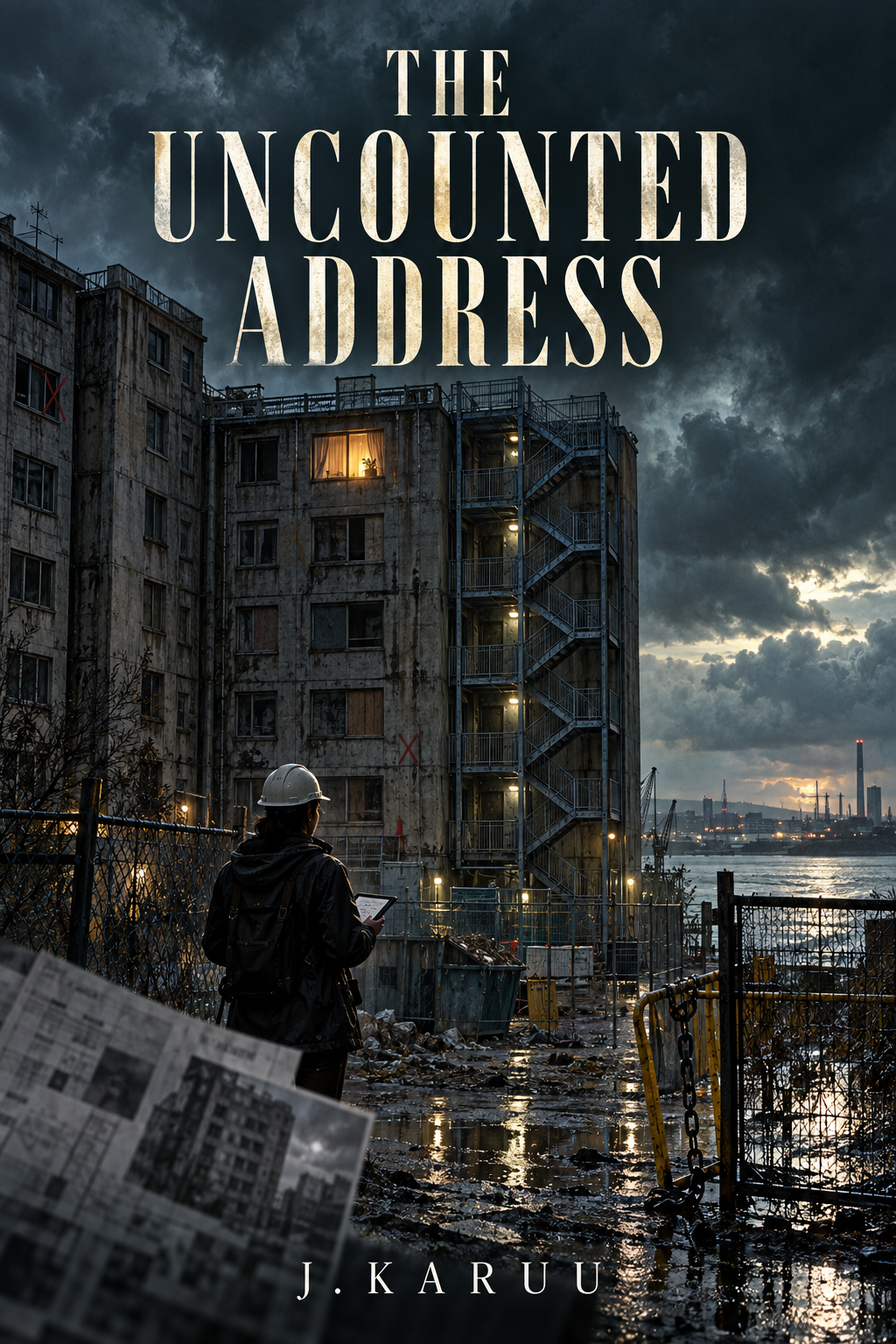
The chain on the west gate had been fastened through the wrong link. Mara could lift it clear without touching the padlock.
She photographed it before going in.
Beyond the fence, Barrow House stood against a strip of pale estuary sky, six storeys of stained concrete with curtains still hanging in a few windows. A torn curtain could survive three clearance visits. So could a plant pot. Neither was proof that someone remained, but Mara had learned to photograph both.
Her earlier photographs showed a yellow barrier across the west entrance. Now the barrier lay beside a skip, one foot buried beneath broken plasterboard.
“Wind took that,” said the man coming from the site cabin.
He wore a clean orange vest over a quilted jacket. His visitor badge identified him as Graham Vale, site liaison. Mara had exchanged emails with him but had not met him before.
“And put it there?” she asked.
“The lads moved it out of the road.”
“The entrance is unsecured.”
“I’ll get someone on it.” He glanced at the tablet under her arm. “We’re still all right for the access release?”
Mara set her bag on a dry concrete bollard and opened the issued report. Her own signature occupied the bottom of the approval page, small and dark beneath the vacancy appendix reference.
“I haven’t been inside.”
“It’s the same building you looked at.”
“Which is why I brought the photographs.”
Vale checked his phone. Behind him, wind stirred a packet caught in the cabin steps.
“The haulage slots are booked for seven tomorrow. Fencing crew first, then the welfare units. If we lose the slots, everything shifts.”
“Mobilization isn’t demolition.”
“No. But it costs money in much the same way.”
She recorded the gate and displaced barrier, then compared the entrance with a photograph taken three weeks earlier. The old central stair had already been enclosed behind plywood then. The temporary stair tower against the courtyard elevation was unchanged: galvanized flights, open treads, scaffold landings meeting the first and second floors.
“Who holds the keys now?” she asked.
“Cabin. Same arrangement.”
“And access restrictions?”
“Central stair’s out. East passage is isolated for stripping. You go through the courtyard and up the temporary.”
“I’ll complete that route before I answer about release.”
Vale’s phone began to ring. He stepped aside, already lifting it.
Mara entered through the west lobby. The air smelled of damp board and adhesive. Rectangles of clean paint marked where notices had been removed. On her first visit, a child’s bicycle had stood beneath the post boxes; today there was a grey wheel mark and a cable tie cut in half.
She stopped at the courtyard door to put on her hard hat.
Across the yard, the temporary stair rose between the building and a low brick store. Its base stood on spreader boards within a fenced channel. Mara looked along the visible braces and connections as she approached. Nothing appeared displaced. The treads were clear, the rails continuous. She photographed the base and the sign directing pedestrians upward.
At the first landing she paused to catch the door before the closer pulled it shut. The corridor beyond was dim, but daylight came through an uncovered window at the far end.
Flat 14 was on her internal route.
She remembered its door: brown laminate, a silver numeral hanging slightly crooked, two screw holes where a second lock had once been fitted. She also remembered standing here while a relocation officer tried a key that would not turn.
They had moved on. The officer had said she would reconcile the access exceptions with housing.
Now the door stood open by the width of a hand.
Mara knocked against the frame.
“Hello? Surveyor.”
No answer. Somewhere inside, a kettle clicked off.
She waited, listening. There was a scrape, then a man said, “Leave it there.”
“Mr—” She checked the schedule. “Mr Serrin?”
“Who wants him?”
She pushed the door a little farther, enough to see through the short hall. A man stood beside a kitchen counter with one hand braced flat against it. Steam lifted from a white kettle. He wore trousers, slippers and a cardigan buttoned unevenly over a vest.
A walking stick leaned within reach. Beside it sat a high chair with wooden blocks beneath its front legs, tilting the seat very slightly backward. Medication packets stood in a shallow plastic tray on the table.
The man turned his head.
“Did I ask you in?”
Mara stepped back over the threshold.
“No. I’m sorry. I’m Mara Venn, the demolition surveyor.”
“That supposed to improve it?”
“I thought the flat was empty.”
He looked toward the kettle, then back at her.
“Well, it’s a complicated illusion.”
She took her identification from its holder and extended it. He did not move to collect it, so she held it where he could read.
“When did you come back?” she asked.
His expression changed. The small amusement disappeared.
“I didn’t.”
“I mean since the relocation visit.”
“I know what you mean.” He shifted his hand along the counter. “I never left.”
Mara glanced down at her issued schedule. The row for 14 had a completion date and the word VACANT.
“May I come in and ask you a few questions?”
“You can ask from there.”
“Of course.”
He studied her, then pointed at her boots.
“Wipe those. They’ve had all sorts through here.”
She wiped them on the mat and entered only as far as the kitchen doorway. The flat smelled of tea and warm bread. A tea towel covered half a loaf. On a drying rack stood one plate, one bowl and two mugs. The refrigerator hummed under the counter.
Ordinary things, none sufficient by itself. Together they made the printed row in her hand feel absurd.
“Are you here every night?”
“Except when I go dancing.”
She let the question rest.
“Yes,” he said. “Every night.”
This is the end of the opening excerpt. Edition options confirm the full EPUB’s language, price and supported purchase regions.