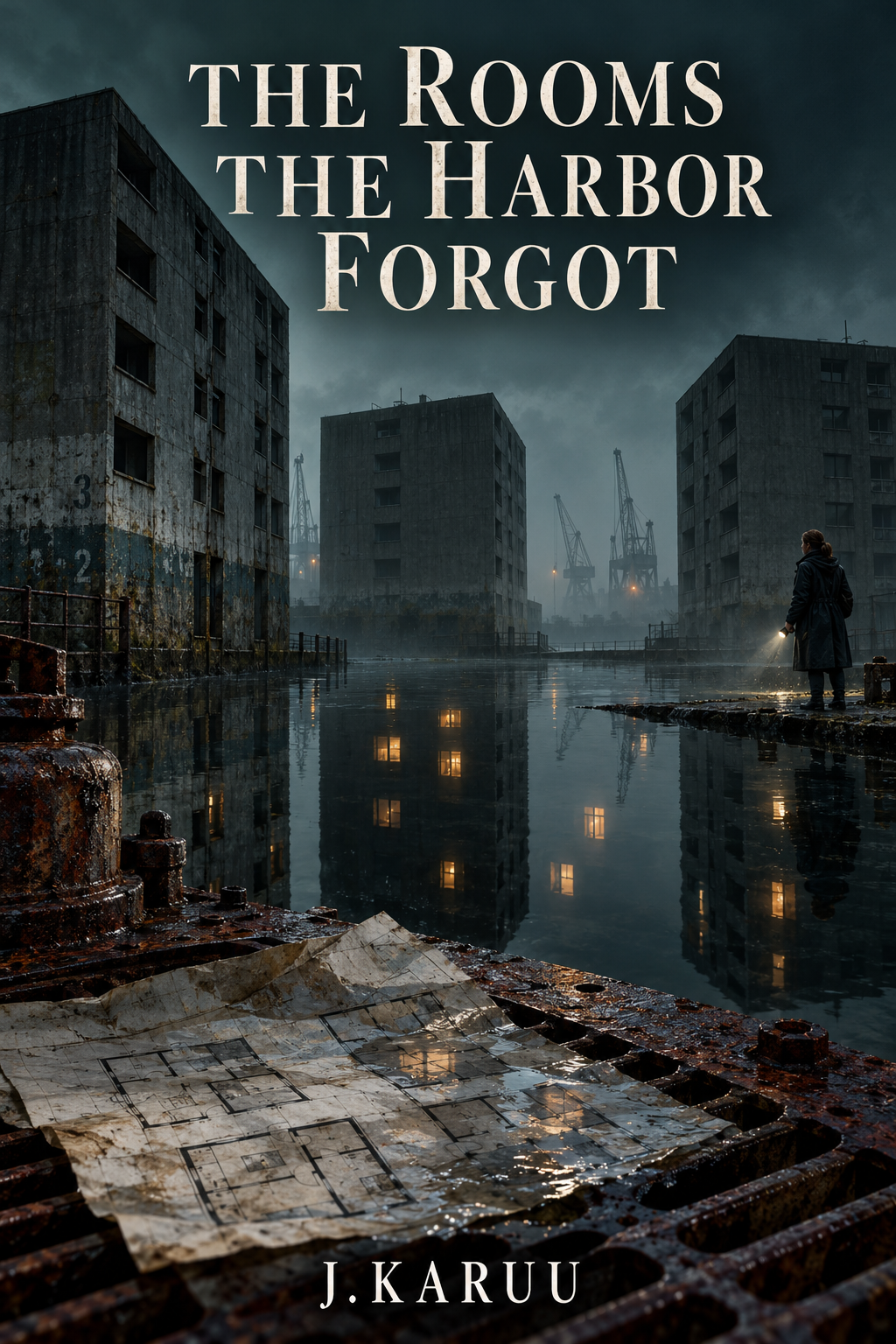
The room they had given Mara contained eleven chairs and no place to hang a wet coat. She counted the chairs while the receptionist looked for her appointment: eight around a table, two beneath the window, one holding a carton of files. Rainwater ran from her cuff onto the municipal reception form.
“Venn,” the receptionist said. “You used to live here.”
“Yes.”
“I thought so.”
Beyond the window, the freight basin lay higher than Mara remembered. Its water concealed the lowest courses of the opposite quay. She knew this was partly the tide and partly the effect of returning as an adult. Neither explanation made her want to look longer.
Celia Brand arrived carrying a laptop under one arm and two mugs in the other hand.
“Coffee? There’s milk already in it. I should have asked.”
“That’s fine.”
Celia put the mugs down, moved the carton from the eleventh chair and offered Mara a seat. Her identification badge had turned backwards. She righted it before sitting.
“We’re borrowing this office until the transfer. The permanent staff are upstairs, so if you need anything that ought to exist and doesn’t, ask them first.”
She smiled. Mara took off her coat and folded it over her knees.
The assignment was straightforward on its face: reconcile the public building inventory with the service-asset schedule before the incoming operator assumed responsibility. Municipal storage, maintenance accommodation, access routes, plant enclosures. Three working days, subject to access. Mara had accepted the fee before enlarging the location map.
Celia opened the schedule beside a plan of the basin frontage.
“The council lists buildings. Our maintenance people list the things they have to service. We need to establish which entries refer to the same things.”
“And which don’t.”
“Exactly.”
For forty minutes, most did. A store had become two stores after a partition was installed. A meter enclosure appeared under both its street address and its plant number. Mara drew a line through neither entry; she linked them in a separate column, with the evidence supporting the match.
Then she reached SC-14.
It sat between a valve recess and a ventilation branch, with an area of eighteen point six square metres. SC-15 followed, then SC-17. Each had an acceptance reference. None appeared on the public plan.
“What does SC stand for?”
“Service cell, I think. Though I’ve also seen service compartment.”
“Where are these?”
Celia turned the plan towards herself. Her finger stopped at the storage building’s rear wall.
“The old works run along here. A lot of the names survived alterations.”
“Eighteen square metres would be a substantial alteration.”
“Could it be an aggregate area? Several recesses under one identifier?”
“It could. I need something that shows that.”
Celia looked at the clock above the reception hatch.
At the back of Mara’s pack was a completion statement. Its first paragraph said she had reconciled all scheduled assets and identified no outstanding discrepancies affecting acceptance. Celia had placed a yellow tab beside the signature line.
Mara slid it out and laid it between them.
“I can report the verified entries today. These go on an exception list.”
“The handover meeting is Thursday.”
“I saw.”
“If they carry the whole property over, the council keeps paying the standby contractor. We’ve already rostered our people. There’s a clinic delivery bay sharing that access road; we can’t have two contractors assuming the other one is clearing it.”
“Then the report should say who clears the road while these are unresolved.”
Celia pressed her fingertips against the edge of the laptop.
“I’m trying to avoid a qualification that makes the lawyers freeze everything.”
“So am I. That’s why it needs to be specific.”
Outside, a reversing alarm sounded and stopped. Celia read the statement again.
“What would you sign?”
“A reconciliation limited to what I’ve verified. With these identifiers excluded pending location and inspection evidence.”
“All right.” She pulled the yellow tab off. “What do you need first?”
“Acceptance history. The signed schedules, their revisions, and whatever inspection attachments supported them.”
“I can get the schedules locally. Attachments may be in central storage.”
“And access to the building.”
Celia reached for her phone. “Graham has the keys. I’ll tell him you’re coming.”
***
Graham met her after lunch beneath a roller shutter with a dent shaped like a shallow bowl. He wore a council fleece under an unbuttoned waterproof and held a ring of keys against his thigh so they would not jangle.
“Someone’s reversed a pallet truck into it twice,” he said, noticing her glance. “Same someone. Different years.”
Inside, the storage building smelled of damp cardboard and road salt. Folded voting booths stood beside stacks of flood sacks. Christmas lights occupied an entire shelving bay, each coil labelled with a street name.
Mara began at the entrance, photographed the door number and measured the main room. Graham shifted a trolley to let her take the second diagonal.
“You’re checking the floor space?”
“Among other things.”
“They’ll have included the walls. They always include the walls when it suits them.”
She showed him the three identifiers.
He read them without taking the sheet.
“Not numbers I use.”
“What do you call the spaces behind here?”
“Stores. Passage. Old intake.”
“Could you show me?”
The rear door was marked 04 on a screwed plastic plate. Beneath it, a rectangle of cleaner paint suggested a larger sign had been removed. Graham unlocked it, then pushed with his shoulder until something scraped clear on the other side.
This is the end of the opening excerpt. Edition options confirm the full EPUB’s language, price and supported purchase regions.