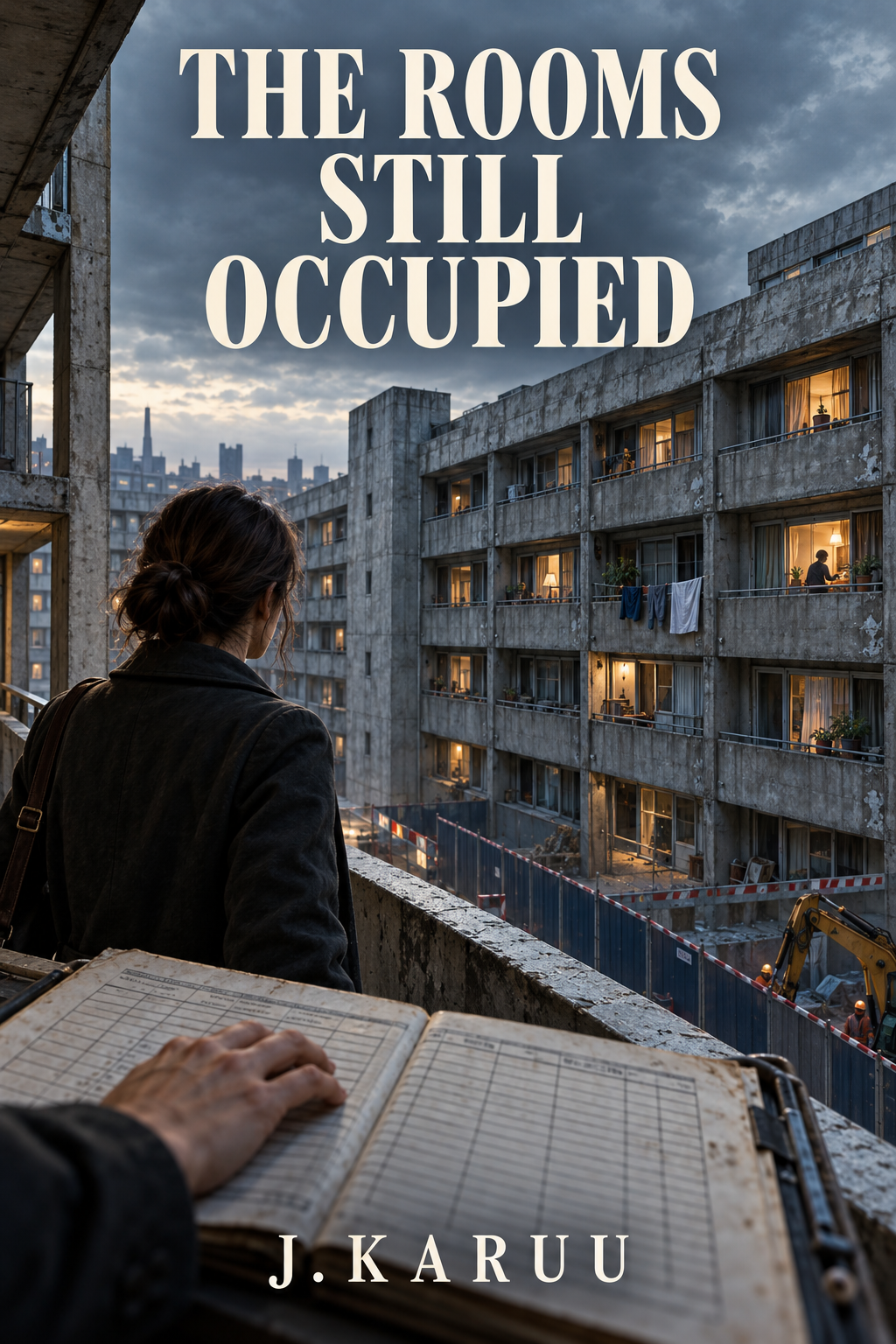
J.KARUU · 1. The Repaired Kettle
The key marked 4-17 opened a cupboard full of salt.
Mara left it in the lock and checked the tag against her schedule. Behind her, rain ticked on the wire-reinforced glass of Block Four’s entrance. The cupboard contained three split sacks of winter grit, a shovel and a fluorescent tube laid across two hooks. Nothing suggested a flat.
Jonah Bell looked down at the keys remaining in his hand.
“They changed the cylinders,” he said.
“When?”
“I’ll find out.”
She wrote the time, 08:34, beside the first address. “Which schedule did they update?”
He gave a small, apologetic movement of his shoulders. His coat was too light for the weather. A dark line had formed where the rain crossed his collar.
At the folding inspection desk inside the entrance, she laid her authorization beside the key schedule. Eleven blocks appeared on the estate plan, arranged around a pedestrian court where weeds had lifted the paving. Her assignment that morning covered a sample in Block Four. The estate certificate clipped behind it concerned all eleven.
She had already told the trust’s administrator that she would not sign the larger document on the strength of one morning’s visit. The administrator had called it a preliminary administrative requirement, which had not improved it.
Jonah found a second ring in his bag.
“Try this set upstairs.”
“Let’s match them here first.”
They worked through the tags. Two keys bore the same flat number. One had no tag, only a strip of green tape. The schedule placed Flat 4-17 on the second residential floor; the entrance directory placed it on the third.
“Ground floor used to be called one,” Jonah said. “Some records kept the old numbering.”
“Are the door numbers current?”
“Mostly.”
She looked up.
“I know,” he said. “I’ll come with you.”
He was helpful in a way she recognized: answering quickly, carrying too much paper, trying to absorb a problem before it reached whoever employed him. On the desk he had placed a flask, two pens and a packet of antacids with one tablet left.
“Before we start,” he said, “the water’s on throughout. Electricity in most units too. Maintenance need it. A running tap doesn’t mean somebody lives there.”
“Agreed.”
“And things get left.”
“Also agreed.”
He seemed relieved until she asked who had independently checked the recorded departures.
“The relocation team closes the household records.”
“That’s who records them. Who checks?”
For the first time, he took a moment.
“That’s partly why you’re here.”
Outside, a reversing vehicle gave three high beeps. Jonah gathered the keys before she could ask him to define partly.
They took the stairs. Someone had painted over the floor numerals, but the old black strokes remained visible through the cream. On the third landing, a door marked 17 stood between 16 and a rectangle of cleaner paint where another number had been removed.
Mara photographed the landing and entered the route she had taken. Jonah offered her a key with green tape.
“This should be it.”
She knocked, announced her name and purpose, then waited. From somewhere lower in the building came the dragging clatter of metal over concrete.
She knocked again.
No reply.
The green-taped key turned cleanly.
Jonah stayed at the threshold while she entered. The flat smelled of cold fabric and washing-up liquid. A narrow hall opened into a kitchen on the left and a sitting room beyond. Both internal doors were open. A closed door on the right had a small brass bolt fitted at shoulder height, though the bolt was not engaged.
She did not open it.
“Any restrictions noted?” she asked.
“None on the access sheet.”
Her contract permitted a visual vacancy inspection, photographs and an inventory of apparent residual belongings. It did not make every drawer hers to open. She called out once more, waited, and began with the kitchen.
A white kettle stood on the draining board. Its handle had yellowed differently from its body. Around the base, someone had replaced the original screws with bright steel ones, and a small square of blue insulating material showed beneath the switch housing.
Beside it sat a washed cup, upside down on a folded tea towel.
The kitchen window was shut. There was no dust ring around the cup and no dust on the exposed half of the towel. On the counter lay a loaf of sliced bread in a supermarket bag. A reduced-price sticker carried Saturday’s date.
Mara took a wide photograph from the doorway before moving closer.
“Could be contractors,” Jonah said.
“Could be.”
She photographed the bread label without touching the bag. The loaf might have been brought in that morning or left over the weekend. It could belong to a worker, a visitor, a resident or someone who had borrowed a quiet room. Its presence answered none of those questions.
In the sitting room, a wooden chair faced the window. It had been placed beside a double socket, close enough that a person sitting there could reach it without rising. One socket held a short charging lead. The other was empty.
She plugged in her approved tester. The indicator lit.
“Power available,” she dictated into her recorder. “No inference as to occupation from supply alone.”
Jonah leaned against the hall wall, then straightened as if he had caught himself doing something improper.
“Eight months,” Mara said.
“What?”
“The recorded vacancy.”
“Yes. February.”
“And no subsequent authorized use?”
This is the end of the opening excerpt. Edition options confirm the full EPUB’s language, price and supported purchase regions.